Showing posts with label high. Show all posts
Showing posts with label high. Show all posts
Thursday, April 30, 2015
High Blood Pressure Symptoms in Young Men Women Children and Teenager
High Blood Pressure (Hypertension) is one of the most wide spread disease in the modern world. As we age the chances of getting this disease increases. Here we will discuss some common symptoms that can help us in diagnosing if we are getting near this health problem.
Mostly there are no clear warning but it should be noticed and treated at right time, otherwise it can be critical for some organs and also life threatening.
These symptoms can occur in any age group of people whether they are young men, women, children or teenager regardless of their age. These symptoms should not be ignored and doctor should be consulted as soon as possible.
If these symptoms are ignored then they might lead to a heart attack or stroke.
Untreated hypertension can lead to serious diseases, including stroke, heart disease, kidney failure and eye problems. That’s why hypertension is known as “silent killer”.
Mostly there are no clear warning but it should be noticed and treated at right time, otherwise it can be critical for some organs and also life threatening.
High Blood Pressure Symptoms in Young Men, Women, Children and Teenager
- Severe and Regular Headache
- Vision Problems (such as Blurred Vision)
- Fatigue or confusion
- Pain in Chest
- Difficulty in breathing
- Irregular heartbeat
- Blood in the urine
- Pounding in your chest, neck, or ears
- Blood spots in the eyes
- Nosebleeds higher than normal
These symptoms can occur in any age group of people whether they are young men, women, children or teenager regardless of their age. These symptoms should not be ignored and doctor should be consulted as soon as possible.
If these symptoms are ignored then they might lead to a heart attack or stroke.
Untreated hypertension can lead to serious diseases, including stroke, heart disease, kidney failure and eye problems. That’s why hypertension is known as “silent killer”.

Sunday, March 8, 2015
True or False High or Low Protein Intakes Have Profound Influence on Testosterone SHBG Estrogen Cortisol Co
 |
| We are what we eat! Acknowledged, but does this also go for your hormones and different in protein intakes? Lets have another look at the contemporarily available research to figure that out. |
I know, anything else would have been a real shocker. What it wouldnt be, though, is a total surprise. If you dig through the available literature you can easily find data that would support the scientists assumption that doing an experiment "to investigate the effects of a controlled typical one day diet supplemented with two different doses of whey protein isolate on blood amino acid profiles and hormonal concentrations following the final meal" (Forbes. 2013) would be a good idea.
True or false? Certainly TRUE!
No, I am not kidding you! We do have plenty of evidence of direct interactions between chronic high vs. low protein intake and the production and metabolism of hormones, like testosterone, cortisol, their corresponding binding proteins, SHGB and CBP, and a whole host of other molecules that act like hormones, although we often dont call them "hormones". Examples? Well, here you go:
- Low protein = low SHBG (Longcope. 2000) - At least in the 1552 men in their "best age" (40-70 years) who participated in a study by scientsts from the University of Massachusetts Medical School the consumption of a diet that had less than the average 80g/day of protein in it lead to decreases in SHBG and corresponding increases in free (~bioavailable) testosterone. Age, dietary fiber, and smoking, on the other hand were positively correlated with SHBG.
- Chronically high protein intakes (40% of total energy) lower testosterone / cortisol ratio (Oi. 2001) - The highly significant increase in cortisol and corresponding decrease in the testosterone to cortisol ratio, Oi et al. report in a 2001 paper have luckily (a) been observed in rodents, only, and thats actually the main finding of the study (b) could be countered by the administration of garlic extract.
I can only speculate whether and to which degree the endocrine effects of high protein diets differ between rats and men (the Anderson study discussed below suggests they dont) - and you know I love facts and hate speculations and unsupported hypothesis. So I stick to an assumption I could support, i.e. the supposition that the improvements in testosterone, the researchers observed, when they fed their rodents garlic was mediated by its glutathione (GSH) boosting effects. These effects - and you as a regular SuppVersity reader know that are not "garlic exclusive". Whey protein, for example will also increase GSH (Bounous. 1989). Obviously whey doesnt increase your testosterone, but a "protein overload" from a glutathione boosting protein source may not have to be countered by GSH boosters in the first place.
Figure 1: In rodents, a high protein intake (40% of total energy from casein) will increase cortisol at stable T-levels and thus decrease the testosterone : cortisol ratio (Oi. 2001) - A high protein : carb ratio decreases total testosterone levels in man (Anderson. 1987) - Some people live by the principle that things that mustnt be. As a SuppVersity reader you obviously dont belong to this group of people and will thus be willing to accept that Anderson et al. were able to show that...
"[...] the testosterone concentrations in seven normal men were consistently higher after ten days on a high carbohydrate diet (468 ± 34 ng/dl, mean ± S.E.) than during a high protein diet (371 ± 23 ng/d1, p<0.05) and were accompanied by parallel changes in sex hormone binding globulin (32.5 ± 2.8 nmol/1 vs. 23.4 ± 1.6 nmol/1 respectively, p<0.01)." (Anderson. 1987)
As a SuppVersity reader you are yet also smart enough to know that this data is irrelevant, without adequately measured free testosterone levels: If we do the math and calculate the latter (obviously not 100% accurately), i.e. free testosterone on normal protein diet: 9.4 ng/dL = 2.01 % vs. free testosterone on high protein + low carb diet: 9.02 ng/dL = 2.43 %, the difference does no longer look so bad, anyway - does it?
This would not change the fact that youd suffered a -42% decrease of the testosterone : cortisol ratio from 60.5 to 35 which occurred in the Anderson study, when the participants were put on a meat, fish, poultry, egg white, and protein supplement based 44% protein, 35% carbohydrates, 21% fat diet.
Figure 2: Total (TT in ng/dL) and free testosterone (FT in ng/dL), SHBG (µg/L) and testosterone : cotisol ratio after one months on high protein + low carb vs. control (Anderson. 1987) - A high protein very low calorie diet can increase testosterone levels, but it will do so only if it is used to produce significant weight loss in obese adolescents, whose abundant body fat stores are gnawing away their androgens. In a corresponding study by Brown et al., the eight 11-15-year-old boys and girls where put on liquid (starvation) diets with a protein / carb / fat ratio of 67% / 28% / 5% that containing a total of 492-709 kcal per day.
As you can see in Figure 3 the significant reduction in body weight (13.5 kg total, 70-75% fat) went hand in hand with improvements in insulin sensitivity and the previously mentioned increase in total testosterone levels in the 14 year-old subjects 3 & 7 and the 18 year-old male adolescents (subject 6) - the only subjects for whom a complete testosterone panel was available.
Figure 3: Total testosterone levels (ng/dl; left axis) and insulin levels (in µU/ml) in 14 (subj. 3 & 7) and 18 year-old male adolescents before and after 5 weeks on low calorie high protein liquid diets (Brown. 1983) - High protein diets are driving forces of GH induced skeletal muscle IGF-1 expression (Sanchez-Gomez. 1999) - With IGF-1 being equally important to men and women, it does not matter that the "subjects" in the study at hand were female growing rats that received either a high- or a low-protein diet with crude protein contents of 222 and 83 g/kg respectively.
After 14 days on which the rodents were concamittantly injected with saline control, or growth hormone (rhGH) or recombinant human IGF-I (rhIGF-I) at dosages of 350 and 500µg/day, respectively, Sanchez-Gomes et al. observed that
...the low-protein diet alone reduced IGF-I concentrations in serum and in tissue taken from the gastrocnemius muscle as well as IGF-I mRNA from the same muscle, significantly.Learn more about IGF-1. - ...the high protein diet amplified the retention of injected rhIGF-I in the muscle tissues and was associated with significant improvements of the nitrogen balance
- Increased f 2-hydroxylation of endogenous estrogen with high protein diets could have cancer protective effects (Anderson. 1984) - Certainly far fetched but not impossible is the connection between the increased 2-hydroxylation of endogenous estrogen in response to high protein diets Anderson et al. observed in a 1984 study in male study participants and the significant association between lower ratios an the risk of breast cancer (Liehr. 1996).
It goes without saying that this is nothing but a hypothesis - a hypothesis that would yet be supported by a 1999 paper on "dietary predictors of breast cancer recurrence and death" by Saxe et al. which is based on one of the few papers that did not control for "meat" intake (you know that Pizza Salami qualifies as "meat", right?) in which each 5% increase in protein intake was associated with risk reductions of 18% for breast cancer recurrence and 44% for death in premenopausal women (Saxe 1999).
Table 1: Cox regression of energy-adjusted dietary predictors of breast cancer recurrence and death (Saxe. 1999)
And whats more, the fact that the associations were less pronounced in the post-menopausal study participants (the "low estrogen counterpart", if you will; see Table 1) only support the notion that the protective effects of protein may (at least in part) be mediated by its effects on estrogen metabolism.

Bottom line - Back to the Forbes study: In view of the conclusive evidence that the changes in total testosterone and cortisol are mediated by (a) changes in the amount of steroid binding proteins in the blood (albumin, SHBG, CBG), (b) weight loss / general health improvements and (c) the scarcity of dietary glucose on high protein diets, its not surprising that the glucose, insulin, testosterone, cortisol, and growth hormone levels of Forbes nine male volunteers (age: 29.6 ± 6.3 yrs), who participated in ...
References:
a control (C) condition of a typical mixed diet containing ~10% protein (0.8 g·kg-1), 65% carbohydrate and 25% fat;
"Protein Requirements of Dieting Strength Athletes: More is Better Only in the Presence of Adequate Carb & Fat Intake. Optimal Muscle Retention With 2-3g/kg Lean Body Mass " | more - a placebo (P) condition calorically matched with carbohydrate to the whey protein conditions;
- a low dose condition of 0.8 g /kg body weight whey protein isolate (W1) per day in addition to the typical mixed diet; or
- a high dose condition with 1.6 g/kg bw. whey protein isolate (W2) in addition to the typical mixed diet,
- Anderson, K. E., Kappas, A., Conney, A. H., Bradlow, H. L., & Fishman, J. (1984). The influence of dietary protein and carbohydrate on the principal oxidative biotransformations of estradiol in normal subjects. Journal of Clinical Endocrinology & Metabolism, 59(1), 103-107.
- Anderson, K. E., Rosner, W., Khan, M. S., New, M. I., Pang, S., Wissel, P. S., & Kappas, A. (1987). Diet-hormone interactions: protein/carbohydrate ratio alters reciprocally the plasma levels of testosterone and cortisol and their respective binding globulins in man. Life Sciences, 40(18), 1761-1768.
- Bounous, G., Gervais, F., Amer, V., Batist, G., & Gold, P. (1989). The influence of dietary whey protein on tissue glutathione and the diseases of aging. Clin Invest Med, 12(6), 343-9.
- Brown, M. R., Klish, W. J., Hollander, J., Campbell, M. A., & Forbes, G. B. (1983). A high protein, low calorie liquid diet in the treatment of very obese adolescents: long-term effect on lean body mass. The American Journal of Clinical Nutrition, 38(1), 20-31.
- Forbes, S. C., McCargar, L., Jelen, P., & Bell, G. J. (2013). Dose Response of Whey Protein Isolate in Addition to a Typical Mixed Meal on Blood Amino Acids and Hormonal Concentrations. International journal of sport nutrition and exercise metabolism.
- Liehr, J. G., & Ricci, M. J. (1996). 4-Hydroxylation of estrogens as marker of human mammary tumors. Proceedings of the National Academy of Sciences, 93(8), 3294-3296.
- Longcope, C., Feldman, H. A., McKinlay, J. B., & Araujo, A. B. (2000). Diet and sex hormone-binding globulin. Journal of Clinical Endocrinology & Metabolism, 85(1), 293-296.
- Sanchez-Gomez, M., Malmlöf, K., Mejia, W., Bermudez, A., Ochoa, M. T., Carrasco-Rodriguez, S., & Skottner, A. (1999). Insulin-like growth factor-I, but not growth hormone, is dependent on a high protein intake to increase nitrogen balance in the rat. British Journal of Nutrition, 81(02), 145-152.
- Saxe, G. A., Rock, C. L., Wicha, M. S., & Schottenfeld, D. (1999). Diet and risk for breast cancer recurrence and survival. Breast cancer research and treatment, 53(3), 241-253.
Artichokes With Creamy Garlic Lemon Pepper Dill Sauce Low Calorie High Fiber Vegan and Gluten Free
 |
| Dip steamed artichokes in this delicious, creamy dill sauce. Serve as an appetizer or in place of the salad course. Follow Foods For Long Life on FACEBOOK . |
Artichokes
I treasure the artichoke. Had I not grown up eating them, I probably would have no idea what to do with this thorny vegetable. But thankfully, artichokes have been a part of my life since I had enough teeth in my mouth to bite the delicious meat off of each succulent leaf.
They are not only delicious but they are a very healthy food. One medium artichoke is only 64 calories yet has a whopping 10 grams of fiber! Artichokes have been shown to reduce cholesterol and stimulate the production of bile which helps in the digestion of fats. This wonderful vegetable also contains the flavonoid silymarin which protects the liver (and is also great for hangovers). Artichoke leaves also contain the phynutrients rutin, quercetin and gallic acid which all have powerful antioxidant properties.
Dill Weed
Fresh dill pairs perfectly with garlic, lemon and black pepper in this flavorful dip. By using a silken or soft tofu as a base, this creamy dill sauce is dairy and gluten free.
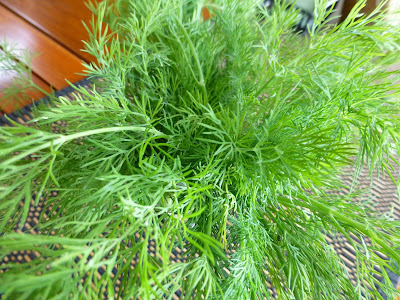 |
| Fresh dill weed |
* * * *
Artichokes with Garlic Lemon-Pepper Dill Sauce
Vegan, Gluten Free
[makes 4 servings]
4 medium artichokes
14 oz package silken or soft organic tofu
2 teaspoons chopped garlic, (2 small cloves)
1 teaspoon grated lemon zest
2 tablespoons freshly squeezed lemon juice
2 tablespoons chopped, fresh, dill weed
1/4 teaspoon freshly ground black pepper
1/2 teaspoon salt
Prepare the artichokes. Pull off any small leaves near the base of the artichoke.
With a sharp knife, cut off the tops (about an inch or so).
With a pair of scissors, cut off the thorny tips of the leaves.
 |
| Trim thorny tips of leaves. |
If the artichokes are really big, (they seem to be growing them larger and larger lately) you can cut them in half, vertically. Most artichokes can be left whole.
Trim the bottom of the stem or remove it, peel it, and cook it with the artichokes.
Clean the artichokes by rinsing them under cold water.
Place artichokes in a large pot with about 2 to 3 inches of water and a steamer basket. Bring to a boil, cover and cook until the outer leaves are tender and easy to remove. Add more hot water to the pot as needed as the cooking time could be as long as 45 minutes to an hour. Start testing outer leaves after 30 minutes.
While the artichokes are cooking, prepare the dipping sauce.
Place the remaining ingredients in a blender and process until smooth.
 |
| This also makes a great salad dressing if you add a touch of extra virgin olive oil or cold pressed hempseed oil or, for a low fat dressing, use as is. |
Divide the sauce into 4 ramekins. Place each ramekin on a plate with one cooked artichoke and serve.
For another presentation idea, remove all the cooked leaves and place them in a circle. Clean the artichoke bottom and place in the bottom of the ramekin. Place the ramekin in the center of the plate.
Place the sauce over the artichoke bottom in the ramekin. When you are finished dipping the leaves, eat the bottom (which I consider the BEST part of the artichoke).
 |
| A presentation idea |
Per serving: 128 calories, 4 g total fat, 0.5 g saturated fat, 288 mg omega-3 and 1,930 mg omega-6 fatty acids, 0 mg cholesterol, 10 g protein, 17 g carbohydrates, 11 g fiber and 371 mg sodium.
Saturday, March 7, 2015
Crispy Raw Vegan And Gluten Free Zucchini Onion Crackers High In Omega 3 Fatty Acid
 |
| Zucchini and onion crackers packed with omega-3. Follow Foods For Long Life on FACEBOOK . |
Its Zucchini Season
About this time each year I search for ways to use up my zucchini. This crispy cracker does the trick! Besides using 2 1/2 pounds of zucchini per batch, these delicious gluten-free crackers deliver 626 mg of omega-3 fatty acid per cracker! Heres how to make them.
Zucchini Onion Crackers
Raw Vegan, Gluten Free
[makes 40 crackers]
Requires a Dehydrator & a tool to grind walnuts
2 1/2 pounds zucchini
1 small onion (6 ounce)
3/4 cups ground flaxseeds
1/2 cup ground English walnuts
2 tablespoons gluten free tamari soy sauce
2 tablespoons freshly squeezed lemon juice
Grate the zucchini on a large grate. You should have about 7 1/2 cups of shredded zucchini.
 |
| Grate the zucchini using the medium grates. |
Cut the onion in half or quarters and thinly slice.
 |
| Slice the onion as thinly as possible. |
Place the zucchini and onions in a large bowl.
If you are grinding your own flaxseeds, start with 1/2 cup of whole flaxseeds to yield the needed 3/4 cups of ground flaxseeds.
Grind the walnuts in a Vitamix, food processor or coffee grinder (reserved for nuts and seeds). You will need 1/2 cup of walnut pieces to yield the needed 1/2 cup of ground walnuts.
Add the ground flaxseeds and walnuts to the bowl of zucchini and onion.
Add the soy sauce and lemon juice to the zucchini onion mixture.
Mix thoroughly until well blended.
 |
| Mix all ingredients thoroughly. |
Divide the mixture between two 14" x 14" inch non-stick dehydrator sheets.
Spread it out into 11" x 11" squares. The mixture will look thick but it will thin out significantly after dehydrating.
 |
| Spread mixture on to 2 dehydrator sheets. |
Dehydrate for 24 hours at 115 degrees F.
 |
| After dehydrating, the mixture will thin significantly. |
After 24 hours, flip over onto mesh dehydrator sheets. Slowly peel off the non-stick dehydrator sheets.
Place back in the dehydrator for another 6 to 10 hours.
 |
| Peel off the non-stick dehydrator sheets slowly. |
Place on a cutting board and cut into crackers with a pizza cutter or sharp knife.
Cut one side into 4 equal pieces and the other side into 5 equal pieces. Each sheet will yield 20 crackers.
 |
| Cut into desired cracker sizes. |
If the crackers are not crisp enough, place individual crackers on the mesh sheet and dehydrate until they reach the desired crispness. (If they still bend, they are not crisp enough).
 |
| Dehydrate until crisp. |
Store in an air tight container and refrigerate.
 |
| Serve with soup, along with dips, or just enjoy as is! |
Per cracker: 26.1 calories, 2 g fat, 0.2 g saturated fat, 625 mg omega-3 and 690 mg omega-6 fatty acids, 0 mg cholesterol, 1 g protein, 2 g carbohydrates, 1 g dietary fiber and 52.5 mg sodium.
Thursday, March 5, 2015
Protein Diet Plan The best high protein diets

Everything you need to know about high-protein diets and how to choose the best one for you


Subscribe to:
Posts (Atom)