Showing posts with label 7. Show all posts
Showing posts with label 7. Show all posts
Sunday, March 8, 2015
ONE WEEK RAW AND GLUTEN FREE Day 7 Learn To Make Raw Meatballs On Zucchini Ribbon Pasta!
 |
| Raw walnut meatballs on ribbons of zucchini with tomato sauce Follow Foods For Long Life on FACEBOOK ! DAY 7 OF "ONE WEEK RAW AND GLUTEN FREE" |
Today is the 7th and last day of our "One Week Raw and Gluten Free" mini cleanse. But it doesnt have to be the end. If you want to extend it a few more weeks, just repeat the recipes you enjoyed during the week. In case you missed any of them, check out DAY 1, DAY 2, DAY 3, DAY 4, DAY 5 and DAY 6.
Todays menu includes:
Breakfast: Strawberry, pear and spinach smoothie
Snack: Leftover pear and apple crisp from last nights dessert
Lunch: Monster salad
Dinner: Raw meatballs on zucchini ribbon pasta
Dessert: Mango and mixed berries
Breakfast:
Strawberry, pear and spinach "green smoothie"
(New Recipe)
Raw Vegan, Gluten Free
[makes 2 servings - enjoy both throughout the morning]
1 1/2 cup frozen strawberries or strawberry tops *
1 large or 2 medium organic pears, cored
2 cups organic, baby spinach
1 tablespoon unrefined flaxseed oil
1 1/2 cups filtered water
Place all ingredients in a VitaMix blender and process until smooth.
Per serving: 190.8 calories, 7.0 g fat, 0.5 g saturated fat, 3.7 g omega 3 and 1.0 g omega 6 fatty acid, 0 mg cholesterol, 2.3 g protein, 35 g carbohydrates and 8.3 g dietary fiber.
 |
| This green smoothie is high in fiber and omega 3 fatty acid. Spinach contains lutein and zeaxanthin which may decrease the risk of age related macular degeneration. |
 |
| * When I clean organic strawberries, I cut off the tops (which include a 1/2 inch of strawberry), freeze them and use them for smoothies. |
 |
| Todays snack is leftover pear and apple crisp. That is, if you didnt eat it all last night! Its sooo good!! |
Lunch
One of the best things you can do for your health is to eat some sort of salad every day of your life. Im not talking iceberg lettuce and thousand islands dressing. Im talking about a HUGE MONSTER salad with as many veggies you can stuff in a bowl topped with more healthful goodies like nuts, seeds and fruit. Todays salad contains many of the leftover ingredients from the recipes we made this week:
red leaf lettuce,torn
baby spinach
daikon, thinly sliced
carrots, thinly sliced
cucumber, thinly sliced
orange bell pepper, thinly sliced
red onion, sliced
broccoli florets
avocado, sliced
raisins
hemp seeds
sunflower seeds
sesame seeds
For the dressing, I had leftover ginger tahini dipping sauce from DAY 6 which I thinned with some freshly squeezed lime juice and a little water. If you ran out, make a little more!
So fill your refrigerator with veggies and experiment with combinations for lunch or dinner each day!
 |
| Todays lunch is a MONSTER salad with many of the leftover veggies from this weeks menus. |
Dinner
Today were going to make little raw meatballs. My poor Italian grandparents, were they alive, would think I was absolutely nuts! But these little guys, made from walnuts and other goodies, really taste meaty!
Were also going to make a raw tomato sauce for our zucchini pasta. When not on a raw cleanse, you can serve this delicious and healthy raw sauce mixed with hot pasta and the raw meatballs (at room temp) on top. They are too delicate to mix in or cook.
Ive posted this on the blog before (in fact it is one of the most "googled" recipes) but its improved and changed a bit to make it gluten free.
Raw Zucchini Ribbons with Walnut Meatballs and Tomato sauce
Old Blog Favorite - modified
Raw Vegan, Gluten Free
[makes 4 servings]
For the zucchini pasta
4 medium zucchini
Freshly ground black pepper
For the raw tomato sauce
1 clove garlic, peeled
1/3 cup sun dried tomatoes, soaked in filtered water for 1 hour, or until soft, and drained
1 Medjool date, pitted and soaked in filtered water for 1 hour and drained
1 cup ripe tomatoes, diced
4 kalamata olives
2 packed tablespoons fresh basil or 1 teaspoon dried
1/2 teaspoon sea salt
1/8 teaspoon crushed red pepper flakes (optional)
2 tablespoons extra virgin olive oil
For the meatballs [makes 12 small meatballs, 3 per serving]
1 clove garlic
1 1/3 cup raw English walnuts soaked for several hours and rinsed
1 tablespoon nutritional yeast
1 tablespoon extra virgin olive oil
2 teaspoons freshly squeezed lemon juice
2 teaspoons Bragg liquid aminos
1 teaspoon thinly sliced green onion, white part only
1 1/2 tablespoons fresh parsley, minced, plus extra for garnish
Make the zucchini ribbons by peeling the zucchini with a potato peeler, gradually rotating with each peel.
To make a thinner spaghetti, use a vegetable slicer. My favorite is Benriner. Wrap the ribbons or spaghetti in a paper towel until ready to use otherwise they will get watery when combined with the sauce.
 |
| Making the zucchini ribbons with a vegetable peeler. |
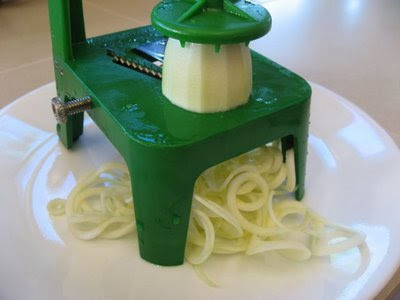 |
| You can make zucchini spaghetti by using a Benriner spiral vegetable slicer. Peel the zucchini first so it really looks like spaghetti! |
To make the sauce, drop a clove of garlic in the chute of a food processor with an S blade while its running. After it is minced, add the drained sun dried tomatoes and date along with the fresh tomatoes, olives, and the rest of the tomato sauce ingredients. Process until smooth, place in a small bowl and set aside.
 |
| Top with extra parsley and freshly ground black pepper and serve! |
Wash and dry the food processor.
To make the meatballs, drop a clove of garlic in the chute of the food processor while its running.
After it is minced, add the walnuts, nutritional yeast, olive oil, lemon juice and Bragg liquid aminos and process until smooth, scraping down the sides when necessary.
Place in a bowl and mix in green onion and parsley.
Form 12 small balls from the mixture, dip each one in tomato sauce to coat and set aside.
Mix the zucchini pasta in the desired amount of sauce. Serve onto 4 plates and top each with 3 sauce covered meatballs.
Garnish with parsley and freshly ground black pepper and serve immediately.
 |
| Tonights dessert is diced mango and an assortment of fresh berries |

Friday, March 6, 2015
Exercise Blunts Insulin Resistance Hyperlipidaemia Due to 7 Day 50 75 Overfeeding in Athletic Young Men
 |
| Gluttony is one of the 7 sins - no wonder that eating more than you "deserve" makes you ugly and sick. |
Nevertheless, Jean-Phillipe Walhin and his colleagues from the University of Bath demonstrate in their most recent paper that the ability of exercise to blunt the ill health effects of short-term overfeeding is a non-negligible part of the health equation.
Dont worry this is a human trial!
For their experiment Jean-Philippe Walhin, Judith D. Richardson, James A. Betts, and Dylan Thompson recruited healthy, "habitually active" male volunteers aged 25 ± 7 years. Eligible were only men who participating in structured vigorous-intensity exercise for thirty minutes or more, at least three times per week. After 26 athletic young men who met these criteria were found, they were randomized to one out of two groups by a third party and put on ...
- a fixed energy surplus for 7 days on which their physical activity was restricted (SUR), or
- the same energy surplus and general activity limit, but w/ daily cardio training (SUR+EX).
The energy expenditure was compensated!
As a regular here at the SuppVersity you will be aware that this study would hardly have made it into the SuppVersity articles, if that, i.e. one group eats + 50% and sits around all day, while the other consumes the same amount of energy and works out, would be all the experiment had to offer. What makes the paper actually interesting is something the scientists marked as "critically" in the abstract to their paper:
"[T]he SUR+EX group received additional dietary energy intake to account for the energy expended during exercise; thus maintaining a matched energy surplus." (my emphasis in Walhin. 2013)Practically speaking this meant that the subjects in the SUR + EX group had to eat even more food to achieve an additional +25% increase in energy intake that was meant to compensate for the extra energy the subjects in this group would be burning during their daily exercise sessions.
Q: How did the scientists know that +25% was the correct number? A: They calculated it: EPOC (6.6% of the energy expended during the run) + diet induced thermogenesis (10%) - energy that would have been expended when the subjects rested = approx. 25% of the baseline intake.
If we take the energy bonus of +25% into account, we are thus dealing with a comparison of a +50% energy intake diet without exercise and a +75% energy intake diet with exercise. Whether or not this would yield a "matched energy surplus" is something I personally dont care about.Why? Well, outside of a metabolic ward you got to rely on a bunch of funky equations and the hilariously stupid assumption that energy intake and energy expenditure would not depend on each other. Against that background, it does not really matter that the data in Figure 1 indicates that the energy surpluses ended up being ca. 18% apart. In view of the unreliability of these kinds of energy in vs. energy out calculations, this is still close enough to qualify the energy surplus as being roughly identical.
 |
| Figure 1: Total energy intake and calculated energy surplus (in kcal/day) in the SAR vs. SAR+EX groups (Walhin. 2013) |
 |
| Figure 2: Relative changes (% of baseline) in glucose + fat metabolism, adiponectin, leptin and alanine transaminase levels (the latter a considered a measure of liver strain) during one week of overfeeding (Walhin. 2013) |
Not shown in Figure 2 are the results of the gene essays the scientists conducted. Unsurprisingly, the results are not significantly different. Its once more the "lazy" SUR group, in whom the gene expression in the fat (=adipose) tissue turned from neutral to pro-diabetic and -dyslipidaemic:
"Seven of 17 genes within adipose tissue were differentially-expressed in the SUR group; expression of SREBP1c, FAS and GLUT4 was significantly up-regulated and expression of PDK4, IRS2, HSL and VISFATIN was significantly down-regulated (P≤0.05)." (Walhin. 2013)It is thus no wonder that AMPK, one of the most important markers we have, when we are talking about issues with blood glucose management (learn more), or, even more specifically, the ratio of phosphorylated to unphosphorylated protein was also significantly down-regulated elusively in the SUR group (P=0.005).
 |
| "Bulking Done Right: +1,000 Kcal/day Overfeeding, Fitness, Fatness, Hormones & More" | more |
In the long-run, the run we are all in, your health and physique are thus going to depend on your ability to control your energy intake, and not on your adherence to a given exercise program. In the short run, and during a strategic bulk (e.g. to build muscle), your workouts will provide a certain degree of protection from the most immediate detrimental health effects of the gluttony the vast majority of our fellow Westerners is indulging in.
- Walhin JP, Richardson JD, Betts JA, Thompson D. Exercise counteracts the effects of short-term overfeeding and reduced physical activity independent of energy imbalance in healthy young men. J Physiol. 2013 Oct 28.
Thursday, March 5, 2015
7 Foods That Are Great For Natural Weight Loss

I healed my body naturally from chronic disease, and in the process lost over 60 pounds, without drugs, deprivation or surgery. Along the way, I discovered that some foods are healing and have the ability to promote health within our bodies, while others can actually cause harm and create weight gain.
Here are some of my personal favorite healing foods that can promote health and support natural weight loss.
1. Broth
When my body broke down, I was bedridden for weeks. As part of my journey back to health, I felt very fortunate to discover the healing power of broth.
Broth can be made easily by cooking chopped organic vegetables in water, until they are super soft. (Bonus points if your vegetables are also local!) Leave six hours or overnight. Then drain the liquid, heat it up, and voila! Your soup broth is ready to drink. Add sea salt and pepper for taste if you want.
You can eat the cooked vegetables seasoned with fresh herbs. (You can also add fish, meat or grains to your broth depending on your preferences.) This can be very healing for your body, since its easy to digest, and also hydrating.
2. Extra virgin coconut oil
Many health experts agree that coconut oil is as close to a superfood that you can get. High in lauric acid (found naturally in breast milk), extra virgin coconut oil is anti-aging, moisturizing, and healing. Its the only oil that you should ever cook with since it stays stable when heated to high temperatures.
3. Apple cider vinegar
Apple cider vinegar is produced through the fermentation of fresh apple cider. Its a rich source of minerals (particularly potassium), vitamins, enzymes and amino acids. Apple cider vinegar is a potent and versatile healing substance and can be applied topically or diluted and taken internally.
Always choose good quality apple cider vinegar made from organically grown apples and aged in wooden barrels. It should be pungent and when held up to the light, you should be able to see a cobweb like formation, called the “mother” suspended in the liquid. Its evidence of the vinegar’s naturalness.
4. Cinnamon
It may be hard to believe that something that tastes so delicious is also so good for your body. Eating cinnamon has the ability to regulate your blood sugars, which is an important part of the weight loss process. Generously sprinkle cinnamon on your cereal or add it to your smoothies for a flavor injection.
5. Lemons
Lemons are naturally detoxifying and have an alkalizing effect on your body. This makes them an ideal weight loss food. Each day upon waking, drink a glass of water with a squeeze of fresh lemon. For a delicious, yet healthy taste, squeeze fresh lemon juice onto your food just before serving.
6. Fresh juices
Drinking a selection of fresh fruit and vegetable juices in your day, your body will certainly feel the benefit. Fresh juices are a powerful way to increase your intake of antioxidants, minerals, vitamins and enzymes. You can juice most fruits and vegetables. I try to choose the greenest, water-rich and most alkalizing ones for my own juices, using some (or all!) of the following: spinach or cucumber, celery, pears, apples, ginger and lemon.
7. Fresh greens and vegetables
I encourage you to try a wide variety of fresh greens and vegetables to find all the ones you like. Always eat your greens according to the seasons. Some of my favorites are baby spinach, parsley, basil green leaves, broccoli, celery, cucumber, and chard.
Healing foods are found everywhere in nature.
Always listen to your body and let it guide you. Your body knows best how to heal itself naturally. Eating healing foods will help.
I hope that this article inspires you to start eating more fresh, local foods so that you can experience the incredible joy that comes from feeling healthy and losing weight naturally, without diets, deprivation or restrictions. If youd like to learn more about healing your body, mind and emotions, please click here to download a free chapter of my book, Losing Weight is a Healing Journey.
By Katrina Love Senn
Source; http://www.mindbodygreen.com/0-13168/7-foods-that-are-great-for-natural-weight-loss.html
Subscribe to:
Posts (Atom)